Everest, the roof of the world

On the border of Nepal and Tibet, Everest dominates the planet at 8,848.86 meters. A symbol of adventure and human achievement, it has attracted dreamers and explorers for generations. More than a mountain, it is a living legend.

Altitude
8848,86 m
Header
A sacred mountain
For Himalayan peoples, Everest is far more than a summit. They call it Chomolungma, the “Mother Goddess of the World,” or Sagarmatha, the “Forehead of the Sky.” Climbing this mountain means crossing a boundary between the world of humans and the realm of the gods.

1953

First successful ascent by Hillary and Norgay

−30 °C

Average temperature at the summit

100 km/h

Wind gusts at the summit

8’848,86

Official height measured in 2020

First woman on the summit
Image & CTA

In 1975, Japanese climber Junko Tabei became the first woman to reach the Everest summit. Her ascent symbolizes determination and empowerment in a male-dominated environment.

A minimalist ascent
Everest

In 2017, Spanish athlete Kilian Jornet climbed via the north side without oxygen or fixed ropes. His fast, lightweight, trail-inspired style redefined high-altitude climbing.

The neighbors of Everest

A universal source of inspiration
Everest remains a universal source of inspiration. Each ascent tells a story of courage and pushing limits, while reminding us that the mountain always has the final say. For Norton Peak, it embodies the spirit of adventure – a demanding quest where precision and beauty meet above 8,000 meters.
Kathmandu, starting point of the adventure
The journey to Everest begins in Kathmandu, Nepal’s capital. A flight leads to Lukla, then the legendary Khumbu trek crosses Sherpa villages, monasteries and high valleys to the South Base Camp at 5,364 m. The adventure begins long before the mountain.

Discover more summits

6812 m
amadablam_header

Ama Dablam

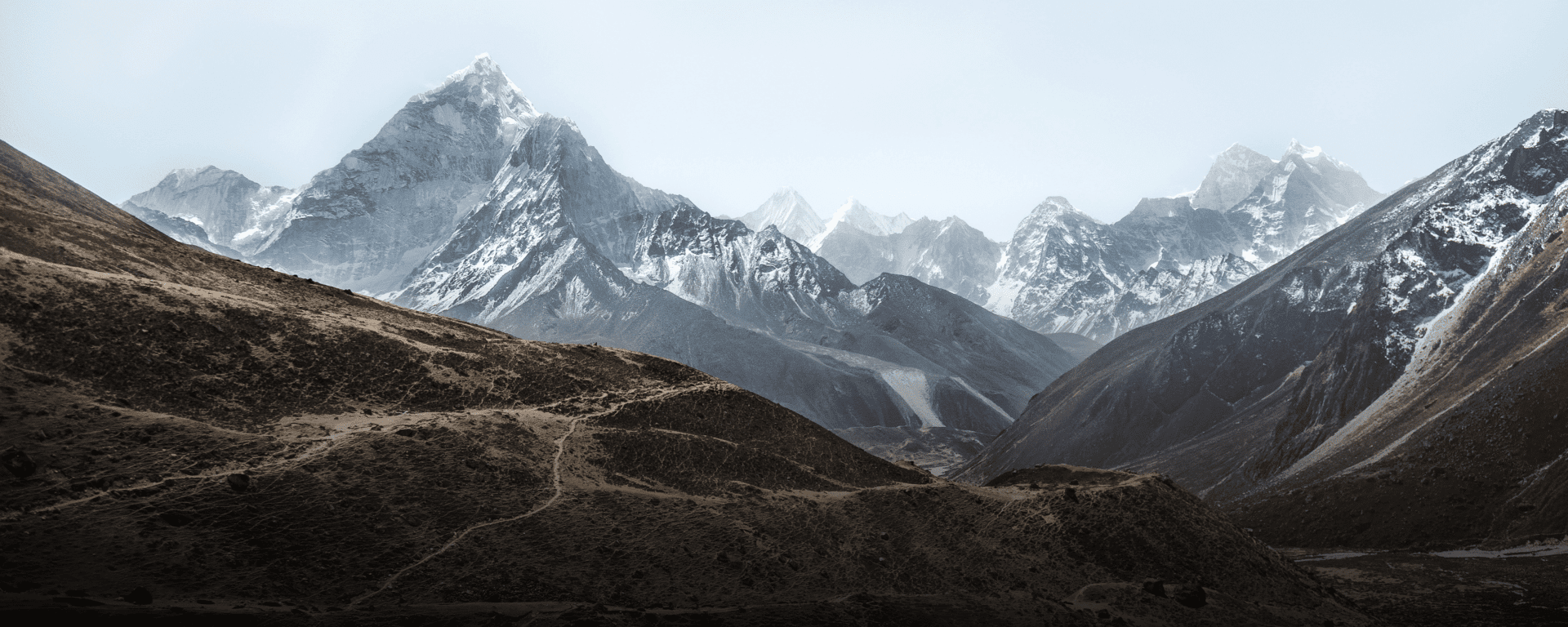
At 6,812 meters, Ama Dablam is one of Nepal’s most iconic and beautiful mountains. Visible from the Khumbu trek toward Everest, it is known as the “Jewel of the Himalaya” thanks to its elegant, pyramid-shaped profile.

8516 m
Lhotse

Lhotse

At 8,516 meters, Lhotse is the fourth-highest mountain in the world. Located just south of Everest, it shares part of its route before diverging into its own path to glory, dominated by a massive and feared south face.

8485 m
Makalu

Makalu

At 8,485 meters, Makalu rises like a perfect pyramid, isolated and formidable. Located on the border between Nepal and China (Tibet), it embodies the raw elegance of high mountains and the harshness of Himalayan challenges.