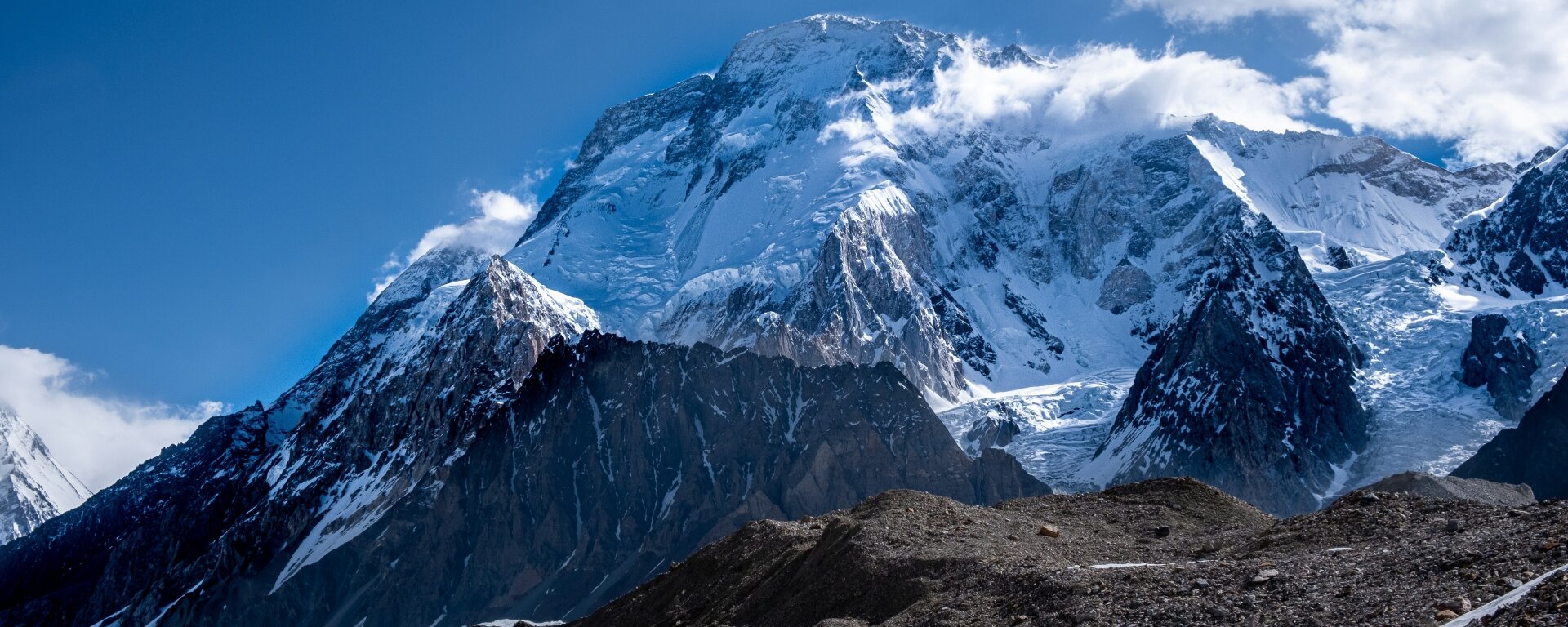
Broad Peak, the long ridge of the Karakoram

Rising to 8,051 meters on the border of Pakistan and China, Broad Peak is instantly recognizable by its profile. Its summit ridge stretches for more than two kilometers, giving the mountain its name and reputation: a demanding giant where altitude meets endurance.

Altitude
8051 m
Broad Peak
A summit of endurance and patience
In the heart of the Karakoram, Broad Peak forces climbers into a very particular rhythm: long, steady, relentless. Its summit ridge stretches for more than two kilometers — a place where every step matters and where shifting weather can turn progress into a true test. Less technical at the start but demanding over its full length, it embodies an alpinism rooted in endurance, clarity and sustained commitment.

8,051 m

Official height of Broad Peak

1957

First ascent by Buhl, Diemberger, Schmuck & Wintersteller

2 km

Estimated length of the summit ridge

−30 °C

Average temperature along the summit ridge

A first ascent in pure style
Cho Oyu

In 1957, the Austrian team led by Marcus Schmuck and Fritz Wintersteller adopted a minimalist strategy: light equipment, fast progression, no high-altitude porters. Their swift, self-supported climb remains one of the most elegant ascents in Broad Peak’s history.

The “false summit” of 1957
Broad Peak

During the first ascent, the team initially reached a high point they believed to be the true summit. Only after traversing the ridge did they realize that the actual summit lay further along. A reminder of Broad Peak’s deceptive terrain.

The neighbours of Broad Peak

A giant of endurance and precision
Broad Peak is a mountain conquered through steady, deliberate progress. Less vertical than its neighbours, yet demanding in length, exposure and mental focus. This measured endurance — purposeful, controlled, exact — echoes the values of Norton Peak: precision as a compass, determination as momentum, and simplicity as strength.
Skardu, the classic approach to the Baltoro
Access to Broad Peak follows the classic Karakoram route. From Skardu, a rough track leads to Askole, the last inhabited village before the glaciers. The trek continues up the Baltoro valley, beneath the walls of Trango and Masherbrum, then reaches Concordia before branching toward base camp at around 4,900 m. A long, spectacular approach through one of the Himalaya’s most iconic landscapes.

Discover more summits

8611 m
K2

K2

At 8,611 m, K2 is the second highest peak in the world after Everest. Located in the Karakoram range on the border between Pakistan and China, it is nicknamed the “Savage Mountain” due to its difficulty and the high mortality rate of its ascents.

8080 m
Gasherbrum I

Gasherbrum I

On the border between Pakistan and China, Gasherbrum I rises to 8,080 meters in the heart of the Karakoram. Long hidden behind broken ridges, it earned the name “Hidden Peak”. Even today, it remains one of the most mysterious and least frequented of the 8,000-meter giants.

8188 m
Cho Oyu

Cho Oyu

At 8,188 meters, Cho Oyu towers over the border between Nepal and Tibet. Its name, meaning “Turquoise Goddess,” evokes the luminous reflections of its glaciers and eternal snows. Less feared than its neighbors, it has nevertheless left a mark on the history of Himalayan mountaineering.